
Types of Work Visas UK 2026: Which Visa Is Right for You?
Thinking about working in the UK? Well, you are not alone. Thousands of people from around the world make the move every year, and for good reason. But before you pack your bags, you need to understand one thing clearly—which of the types of work visas UK offers is right for your situation.
There are many different ways for people who want to live and work in the UK to do so. And each one has its own rules, costs, and time frames. It’s important to know the types of work visas UK before you apply.
In this guide, we break down every major UK visa type for work available in 2026, who each one is designed for, and what you need to qualify. Whether you are a skilled professional, a student transitioning into work, or someone comparing the types of work permit in UK options from abroad, this is your starting point.
What is the Skilled Worker Visa?
The Skilled Worker Visa enables people to live and work in the UK for an approved employer. It often applies to eligible, skilled roles and can lead to permanent settlement after five years.
To qualify, you need a confirmed job offer from a UK-licensed sponsor, a role that meets the required skill level (RQF Level 3 or above), and a salary that meets the minimum threshold set by the Home Office. It is the most commonly used work permit type UK applicants pursue because it is flexible, well-established, and leads to permanent residence.
Once granted, this visa can lead to Settlement and ILR after five years, which makes it one of the most valuable immigration routes available.
Types of Work Visas UK: Brief Breakdown
When people search for the types of work visas UK offers, they expect a simple list. And every visa type has different rules and a purpose. Understanding the types of skilled worker visa UK applicants can access, alongside the broader types of UK work visas, is what allows you to choose the right route confidently.
Take a look at every major UK visa type for work in 2026:
1. Skilled Worker Visa
The most widely used route across all types of work permit in UK categories. It is suitable for people with a job offer in a role in the UK’s eligible occupations list. Also, the applicant should have a minimum of 70 points under the point-based system. It covers factors like job offer, salary level, and English language ability.
Best for: Professionals in healthcare, IT, engineering, finance, education, and many other sectors.
2. Health and Care Worker Visa
A subcategory of the Skilled Worker Visa, specifically for doctors, nurses, allied health professionals, and adult social care workers. It comes with reduced visa fees and faster processing. It offers a significant benefit for NHS and care sector employers. This is one of the most in-demand types of skilled worker visa UK workers apply for.
Best for: Medical professionals and care workers with an offer from an eligible health or social care provider.
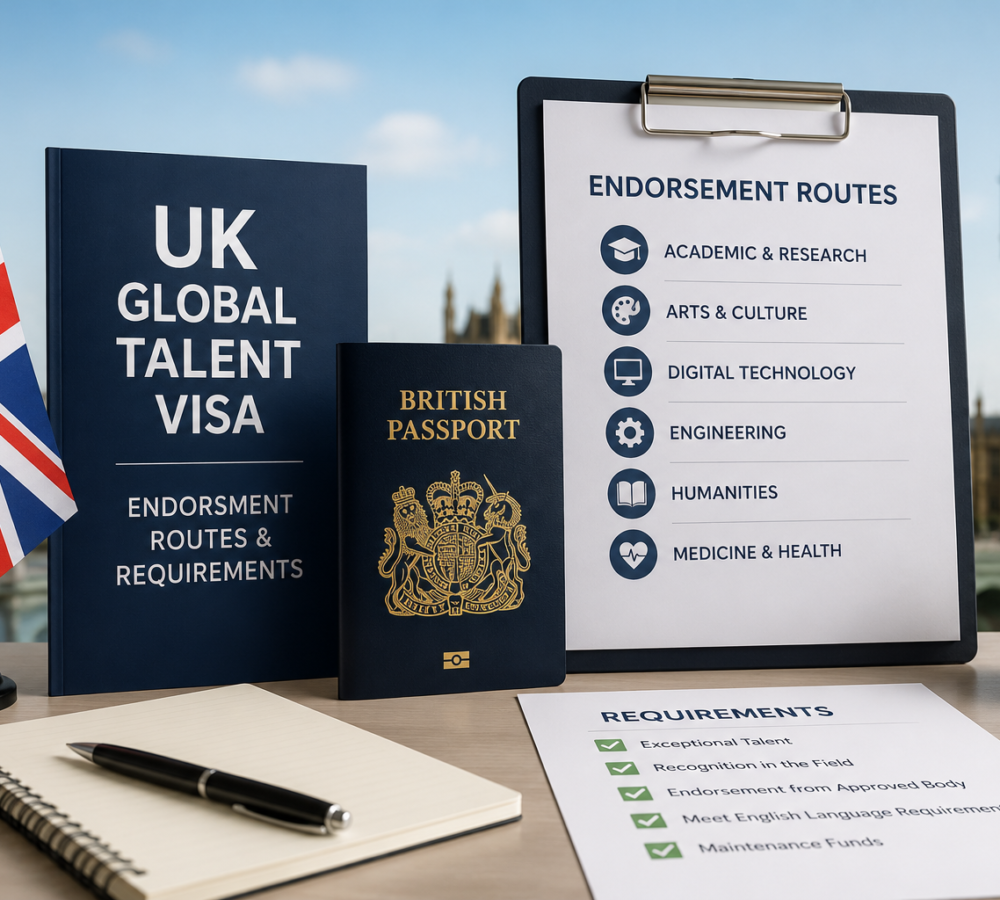
3. Global Talent Visa
For people who are well-known leaders or up-and-coming stars in the fields of research, the arts, culture, or digital technology. You don’t need a job offer, but you do need to be approved by an endorsing body that the Home Office trusts.
Best for: Researchers, scientists, artists, and tech innovators with an established reputation in their field.
4. Intra-Company Transfer Visa
If you already work for a multinational company and are being transferred to a UK branch, this is the route you will use. You must have been employed by the company overseas for at least 12 months in most cases. Among the types of UK work visas, this one is unique in that your employer initiates the process.
Best for: Employees being relocated to the UK by their existing employer.
5. Scale-up Worker Visa
Introduced for fast-growing UK businesses, this visa allows skilled workers to join a qualifying scale-up company. After six months, you are free to work for any employer, which gives you the flexibility most other types of work visas UK applicants encounter do not have.
Best for: Professionals joining high-growth UK companies..
6. Graduate Visa
It is not a traditional work permit type, UK applicants start with, but it’s important to understand. If you have recently completed a UK degree, the Graduate Visa lets you stay for two years (three for PhD graduates) to work or look for work without needing a sponsor. Many graduates use this as a stepping stone to a Skilled Worker Visa.
Best for: International students transitioning into UK employment.
7. Seasonal Worker Visa
For short-term agricultural and horticultural work in the UK. It allows you to work for up to six months and is designed to fill seasonal labour shortages in the farming sector. Among all types of work permits in UK routes, this is the most time-limited.
Best for: Workers seeking temporary seasonal employment in agriculture.
Work Visa Application Process—Step-by-Step
Understanding the types of work visas UK offers is one thing, but you should learn how to apply. Here is the step-by-step process for the most common route, the Skilled Worker Visa:
Step 1: Secure a job offer from a licensed sponsor
Your employer must hold a valid Skilled Worker sponsor licence. Without this, your application cannot proceed, regardless of which UK visa type for work you are pursuing.
Step 2: Receive your Certificate of Sponsorship (CoS)
Your employer issues this digitally. It contains a unique reference number you will need for your application.
Step 3: Check you meet the eligibility criteria
Use the Home Office points calculator to confirm your points score, salary eligibility, and English language requirement.
Step 4: Gather your documents
Pull together everything listed in the requirements section below. Missing documents are one of the most common reasons for delays and refusals across all types of UK work visas.
Step 5: Apply online
Submit your application through the UK Visas and Immigration (UKVI) portal. Pay the visa fee and the Immigration Health Surcharge (IHS) at this stage.
Step 6: Book your biometrics appointment
You will need to attend a visa application centre to give your fingerprints and photograph.
Step 7: Wait for a decision
Standard processing is around three weeks. Priority and super-priority services are available for faster decisions.
If you want expert help navigating this process, our Skilled Worker Visa service at GMS Immigration offers step-by-step support from application to approval.
UK Work Visa Cost 2026
Immigration is a huge investment.
- Application Fee: £719 to £1,500+, depending on duration.
- IHS Fee: £1,035 per year (Standard).
- Sponsor Fee: Immigration Skills Charge (paid by the employer)
UK Skilled Worker Visa Requirements
Understanding UK Skilled Worker Visa requirements is essential before applying, as applicants must meet several key criteria:
1. Points-Based System (PBS)
Most work visas are evaluated under the PBS, where the applicants must score specific points for sponsorship, salary, and skills.
2. Sponsorship
For sponsored work routes, workers can only proceed with their visa application once they get a Certificate of Sponsorship (CoS) from their sponsor.
3. English Language Proficiency
Most skilled work visa applicants need to prove their knowledge of English by giving an English language test certificate.
4. Financial Ability
Applicants should have enough funds to maintain themselves and any dependants without requiring public funds.
5. Health Requirements
Applicants should provide an approved tuberculosis certificate for entry.
Documents You’ll Need to Apply for a UK Skilled Worker Visa
Getting your paperwork right the first time saves significant delays. This applies to all types of work permit UK applications. Here is the standard document checklist:
- Valid passport or travel document
- Certificate of Sponsorship (CoS) reference number
- Proof of English language ability (test results or exemption evidence)
- Proof of your current salary or job offer letter
- Bank statements showing you have sufficient funds (at least £1,270 held for 28 consecutive days, unless your employer certifies maintenance)
- Tuberculosis (TB) test results if you are applying from a listed country
- Academic qualifications (if relevant to your role or salary concession)
- Criminal record certificate (for certain roles, such as those working with vulnerable people)
Our advisers at GMS Immigration review every document before submission to make sure nothing is missing. It is a step that has helped many of our clients achieve approval the first time.
Living in the UK on a Work Visa
Once you arrive in the UK on one of the types of UK work visas, there are a few things worth knowing:
You can bring your family: Your spouse or partner and dependent children can apply to join you in the UK. They will have the right to work and study here too.
Your visa is tied to your sponsor: If you change jobs, you will need a new CoS from your new employer. Changing roles within the same company may also require an update to your sponsorship.
After five continuous years in the UK on a qualifying visa, you can apply for Indefinite Leave to Remain (ILR) and eventually British Citizenship.
Healthcare is covered. The IHS you pay as part of your application gives you full access to the NHS during your stay.
Also, one question that most people ask about is a working visa for the USA from the UK. It is a separate process governed entirely by US immigration law and handled through the US Embassy. If you are already in the UK and looking to move to the US, GMS Immigration specialises exclusively in UK immigration routes, so for US-bound applications, you would need to consult a US immigration specialist.
In The End
The types of work visas UK are of different types as per different needs, which include sponsored skilled roles to the talent-focused unsponsored route. However, for the latest updates, always refer to the official GOV.UK and consult with the best immigration services provider.
We at GMS Immigration helped hundreds of clients across all types of UK work visas. We are there at every step, from initial eligibility checks to the final approval. Our consultants guide you in every case, whether it’s straightforward or complicated. Book a free consultation now.
FAQs (Frequently Asked Questions)
How can I apply for a skilled work visa in the UK?
Pick the right route, check eligibility, and then apply online. And if your route is sponsored, you should submit a Certificate of Sponsorship. Verify your identity through the app or at a visa centre, pay the fees, and upload your evidence.
What are the fees for a UK work visa?
The different types of work visas UK has different fees and can change depending on route, pay type, and where you apply.
How long does a UK work visa take to process?
Timelines vary depending on the route and location. Certain applications qualify for priority services for an additional fee. Before applying, check the current estimated times for your route, taking into account biometrics and any document checks.
Is it possible to switch to a work visa inside the UK?
Well, switching depends on your current status and the target route. However, short-term and visitor visas cannot be switched in the country. So, it’s vital to check route-specific rules before you apply.
What to do if my work visa is refused?
You will get a decision letter explaining the reasons. And if eligible, you can ask for an administrative review. In some cases, you may need to reapply with stronger evidence.