

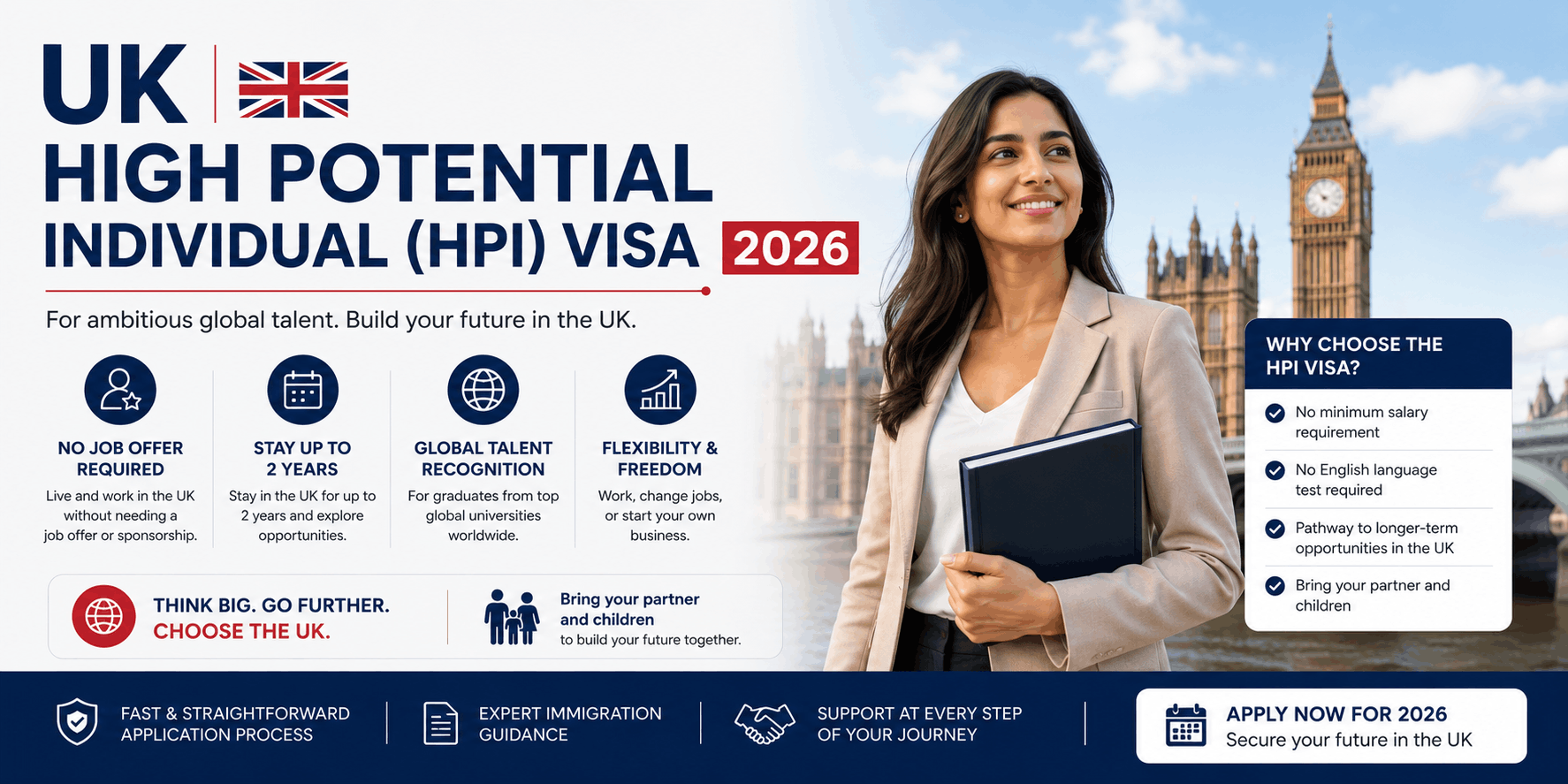
The UK High Potential Individual (HPI) visa lets graduates of the world’s top-ranked universities work, look for work, or run a business in the United Kingdom for two years (three years for PhD holders) without needing a job offer or a sponsor. It was introduced in May 2022 as part of the UK’s post-Brexit talent strategy and remains one of the least-known but most flexible work routes in the system.
Unlike the Graduate Route, the HPI visa is open to applicants who completed their degree at a non-UK university — provided that university appears on the official Global Universities List for the year you graduated. If you graduated in the last five years from a top-50 institution worldwide, the HPI route gives you the freedom to come to the UK, take any job, switch employers, or start a business — all without needing sponsorship.
Each year the Home Office publishes a Global Universities List for the HPI visa. To qualify, your university must have appeared on the list for the year you graduated. The list combines top-50 rankings from three sources: QS World University Rankings, Times Higher Education World University Rankings, and Academic Ranking of World Universities (the ‘Shanghai’ ranking).
Universities consistently on the 2024–25 HPI eligible list include:
| Country | Universities (selection of those on the 2024–25 list) |
| United States | Harvard, MIT, Stanford, Princeton, Caltech, Yale, Columbia, Penn, Chicago, Cornell, Berkeley, UCLA, Northwestern, Johns Hopkins, Duke, NYU, Carnegie Mellon |
| Canada | University of Toronto, University of British Columbia, McGill University |
| Switzerland | ETH Zurich, EPFL |
| Singapore | National University of Singapore, Nanyang Technological University |
| Australia | University of Melbourne, ANU, University of Sydney, Monash, UNSW |
| Japan | University of Tokyo, Kyoto University |
| Hong Kong / China | University of Hong Kong, HKUST, Tsinghua, Peking, Fudan, Shanghai Jiao Tong, Zhejiang |
| Europe | Karolinska Institute (Sweden), KU Leuven (Belgium), LMU Munich, Heidelberg, Paris Sciences et Lettres, Sorbonne |
| South Korea | Seoul National University |
| Critical point — the year you graduated determines which list applies. If you graduated in 2020, you must be on the 2020 list (not the 2025 list). The Home Office publishes a separate list for each year going back to 2016. Always cross-check. |
You do NOT need a job offer, a sponsor, or a minimum salary.
| Cost item | Amount |
| Application fee | £822 |
| Immigration Health Surcharge — 2-year visa | £2,070 |
| Immigration Health Surcharge — 3-year visa (PhD) | £3,105 |
| Ecctis academic qualification verification | £140 – £210 |
| English language test (if required) | £150 – £180 |
| Priority service (optional) | £500 |
Total minimum cost: approximately £3,200 for a two-year HPI visa or £4,200 for a three-year PhD HPI visa, before priority service. The Ecctis academic qualification verification is mandatory and often the step applicants forget — start it 4–6 weeks before applying.
Documents required
| Feature | HPI Visa | Graduate Route | Skilled Worker |
| Eligibility | Top-50 global university grad (last 5 yrs) | UK degree from licensed institution | Job offer at RQF 6+ |
| Apply from outside UK? | Yes | No (must be in UK) | Yes |
| Sponsor required? | No | No | Yes |
| Job offer required? | No | No | Yes |
| Min salary? | None | None | £38,700 (or £30,960 new entrant) |
| Duration | 2 yrs (3 yrs PhD) | 2 yrs (3 yrs PhD) | Up to 5 yrs per CoS |
| Extendable? | No | No | Yes |
| Counts toward ILR? | No | No | Yes |
| Can bring dependants? | Yes (incl. new ones) | Existing only | Yes |
The HPI visa gives you almost complete freedom in the UK labour market for the duration of your visa:
You cannot work as a professional sportsperson or claim public funds.
The HPI visa cannot be extended and does not count toward the five years required for ILR. Most HPI holders use the two-year period to find a sponsoring employer and switch to a Skilled Worker visa. To switch you need:
From the date your Skilled Worker visa is granted, the five-year clock for ILR begins. Time on the HPI visa does not carry over.
Unlike the Graduate Route, the HPI visa allows you to bring new dependants from outside the UK at any point during your visa. Your spouse, civil partner, unmarried partner (with two years of cohabitation), and children under 18 are all eligible.
Each dependant pays £822 plus IHS. Maintenance funds increase to £285 for a partner and £315 for each child.
Frequently asked questions about the HPI visa
How is the HPI visa different from the Graduate Route?
Both have similar rules once you arrive, but the HPI is for overseas graduates of top-50 universities applying from anywhere in the world, whereas the Graduate Route is for international students who have just completed a degree at a UK institution. Use HPI if you studied abroad; use Graduate Route if you studied in the UK.
Can I apply if I graduated more than five years ago?
No. The HPI visa requires applicants to have graduated within the five years immediately before applying. If your graduation date is more than five years old, you must use a different route — typically Skilled Worker.
Does an MBA count?
Yes, an MBA is an RQF Level 7 qualification and qualifies provided the awarding institution is on the eligible Global Universities List for the year you graduated. Many top business schools (e.g. Wharton, INSEAD, Harvard Business School) feature on the list.
What if my university is on the list one year but not another?
What matters is whether your university was on the list in the year you graduated. If it appears for 2023 but not 2024, applicants who graduated in 2023 are eligible; applicants who graduated in 2024 are not. Always confirm against the archived list for your specific year.
Can I extend the HPI visa?
No. The HPI visa is non-extendable. After two years (or three for PhD holders) you must switch to another route — most commonly Skilled Worker — or leave the UK. There is no second HPI visa.
Does the HPI visa lead to settlement?
Not directly. Time on the HPI visa does not count toward ILR. To reach ILR you need to switch into a settlement-eligible route such as Skilled Worker, Global Talent, Innovator Founder, or Spouse visa.
Apply for your HPI visa with GMS Immigration
The HPI visa is one of the simplest UK work visas to qualify for if your university is on the list — but the Ecctis verification step trips up many applicants and slows the timeline by weeks. We at GMS Immigration manage the full process: confirming list eligibility, fast-tracking Ecctis, preparing financial maintenance evidence, and sequencing the visa with any future Skilled Worker switch. Contact us on 020 8059 0483 or baljit@gmsimmigration.co.uk.

A UK Dependent Visa allows the spouse, civil partner, unmarried partner, or child under 18 of a main visa holder to live in the United Kingdom for as long as the main visa is valid.
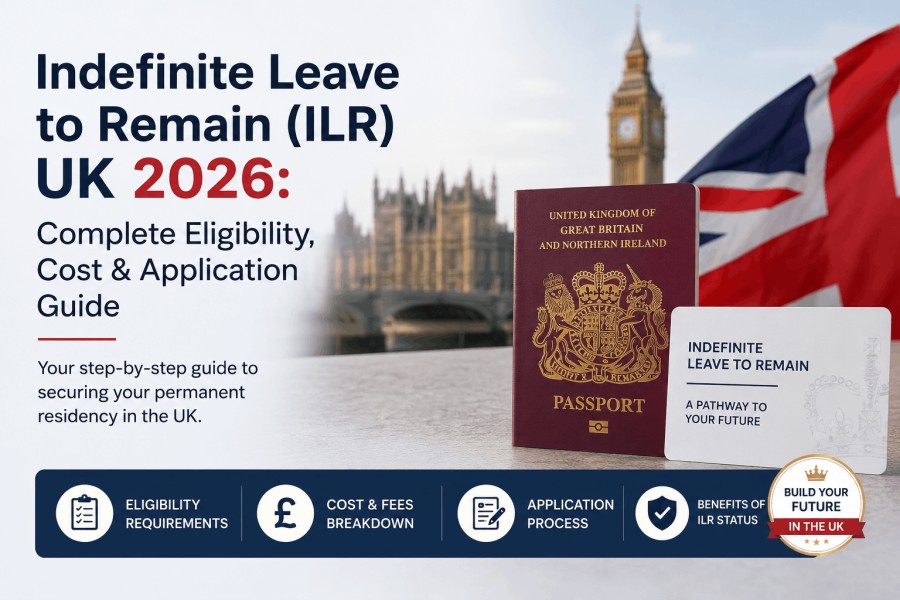
Indefinite Leave to Remain (ILR) is the UK immigration status that lets you live, work and study in the United Kingdom without any time limit. Once granted, you can stay forever, switch jobs freely, claim public funds, and after 12 months you become eligible to apply for British citizenship.

Understand UK Student Visa Requirement, updates, eligibility, costs, and application steps for 2026. Explore your UK student visa application process.

UK Family Reunion Visa explained clearly—documents, process, and approval tips. Avoid common delays and apply with confidence. Learn more.

Apply for a Sponsor Licence UK with a clear step-by-step process. Avoid delays and errors. Learn what documents and checks matter most.

Explore the types of UK work visas in 2026 and find out which option best suits your skills, job role, and career goals.

Learn about the UK eVisa 2026, including ETA, application steps, requirements, and the latest updates to help you travel to the UK smoothly.

Check UK tourist visa requirements for 2026. Learn documents, eligibility, and steps to apply. Start your UK visit visa application with expert help.

Move to the UK without studying—Skilled Worker Visa 2026 with eligibility, requirements, and steps.

Learn the difference between a UK spouse visa and a UK fiance visa.
Both have similar rules once you arrive, but the HPI is for overseas graduates of top-50 universities applying from anywhere in the world, whereas the Graduate Route is for international students who have just completed a degree at a UK institution. Use HPI if you studied abroad; use Graduate Route if you studied in the UK.
No. The HPI visa requires applicants to have graduated within the five years immediately before applying. If your graduation date is more than five years old, you must use a different route — typically Skilled Worker.
Yes, an MBA is an RQF Level 7 qualification and qualifies provided the awarding institution is on the eligible Global Universities List for the year you graduated. Many top business schools (e.g. Wharton, INSEAD, Harvard Business School) feature on the list.
What matters is whether your university was on the list in the year you graduated. If it appears for 2023 but not 2024, applicants who graduated in 2023 are eligible; applicants who graduated in 2024 are not. Always confirm against the archived list for your specific year.
No. The HPI visa is non-extendable. After two years (or three for PhD holders) you must switch to another route — most commonly Skilled Worker — or leave the UK. There is no second HPI visa.
Not directly. Time on the HPI visa does not count toward ILR. To reach ILR you need to switch into a settlement-eligible route such as Skilled Worker, Global Talent, Innovator Founder, or Spouse visa.
The HPI visa is one of the simplest UK work visas to qualify for if your university is on the list — but the Ecctis verification step trips up many applicants and slows the timeline by weeks. We at GMS Immigration manage the full process: confirming list eligibility, fast-tracking Ecctis, preparing financial maintenance evidence, and sequencing the visa with any future Skilled Worker switch. Contact us on 020 8059 0483 or baljit@gmsimmigration.co.uk.

GMS Immigration is a trusted UK-based visa consultancy offering expert guidance for visitor, work, family, and settlement visas.With over 10 years of experience and a high success rate, they provide personalised, transparent support to help clients achieve their UK immigration goals.