

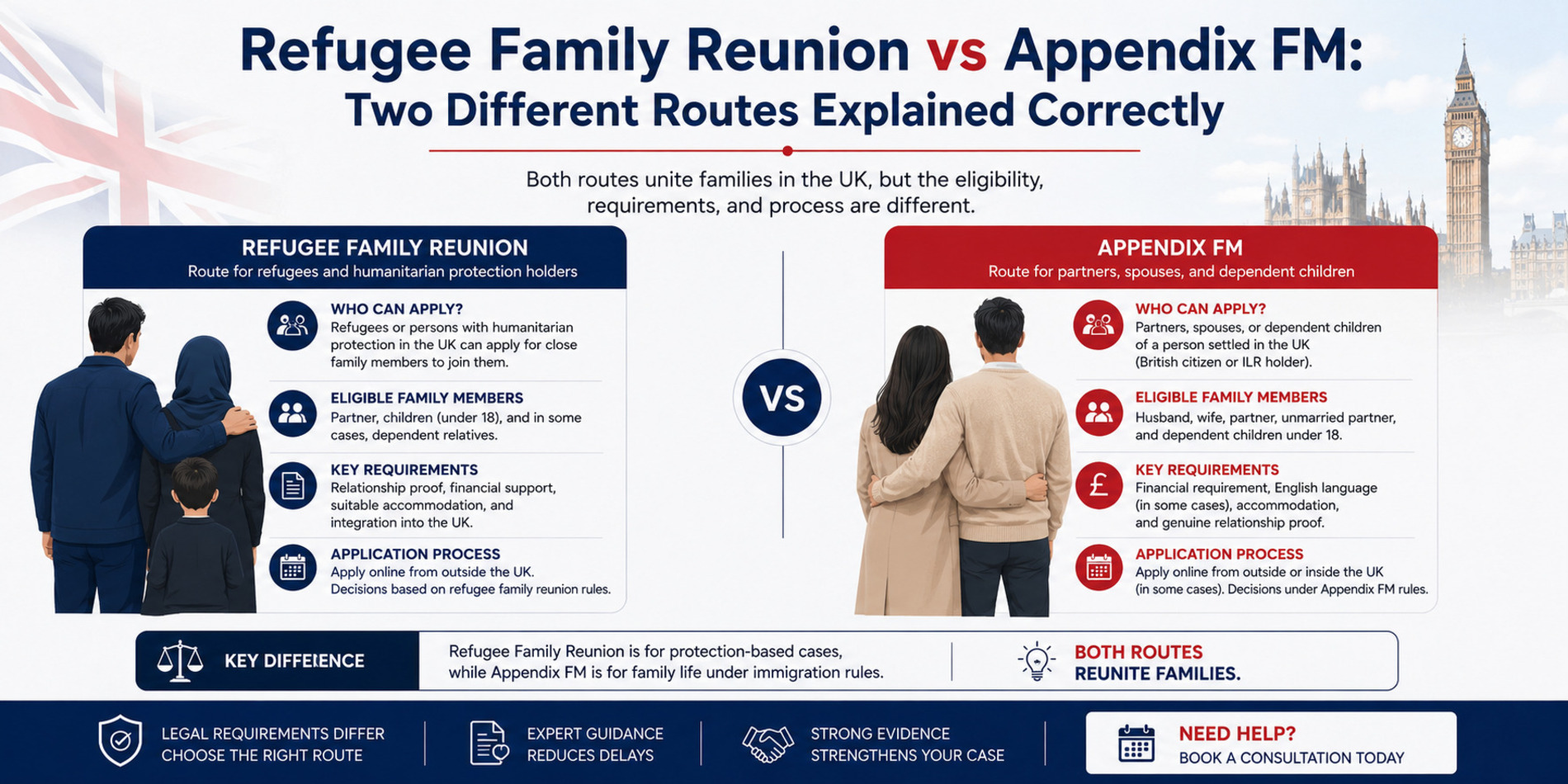
For families separated by conflict or persecution, receiving refugee status in the UK is often only one part of the journey. The next thing is bringing loved ones safely. That is where many families encounter an unexpected challenge: understanding which immigration route actually applies to them.
Information about Refugee Family Reunion, Appendix Family Reunion, and Appendix FM is often discussed together, even though these routes serve different purposes and can involve different requirements. Families researching their options today may find older guidance sitting alongside newer rules. This makes it difficult to determine which pathway is relevant to their circumstances.
The distinction matters. Eligibility criteria, evidence requirements, application costs, and language or financial obligations can vary significantly depending on the route being used.
Our blog explains the difference between refugee family reunion UK routes, UK family reunion routes under the Immigration Rules, and Appendix FM.
Before looking at Appendix Family Reunion and Appendix FM, it is better to understand where refugee family reunion UK provisions fit within the wider system of UK family reunion routes.
Family migration rules are generally designed for people who choose to move to the UK and later wish to bring family members with them. Refugees and people granted humanitarian protection are in a very different position. Separation from a spouse, partner, or child is often a direct consequence of conflict, persecution, or forced displacement rather than a personal choice.
The UK's Refugee Family Reunion framework was developed to address those circumstances. Its purpose has traditionally been to allow certain close family members to join a person whom the UK has already recognised as needing international protection. The route reflects the principle that protection should not only focus on an individual's safety but should also take account of family unity, where the Immigration Rules permit. The Home Office has long recognised family reunion as an important part of refugee protection policy.
In simple terms, Refugee Family Reunion UK is a route that enables eligible family members of a person with refugee status or humanitarian protection to apply to join them in the UK.
Historically, the route primarily covered:
The exact eligibility requirements depend on the Immigration Rules in force at the time of application and the relationship between the sponsor and the applicant. Unlike standard family migration routes, the focus has traditionally been on maintaining family unity for those who have already been recognised as needing protection.
The route is most commonly associated with individuals who have been granted:
For families affected by displacement, this can provide a lawful pathway for reunification without relying on the same requirements that apply to many other family visa categories. However, eligibility has never been automatic. The relationship must fall within the scope of the Immigration Rules, and supporting evidence remains an important part of the application process.
The reasoning is largely practical. A person fleeing persecution rarely has the opportunity to plan their migration journey in the same way as someone relocating for work, study, or family reasons. Families may become separated suddenly, documents may be lost, and returning to obtain evidence may be impossible or unsafe.
For that reason, refugee family reunion developed separately from mainstream family migration routes. This distinction also explains why discussions about financial requirements, English language tests, and sponsorship obligations often look very different when comparing refugee family reunion with Appendix FM.
That comparison is where much of today's confusion begins. To understand why the two routes are increasingly discussed together, the next step is to examine the legal framework behind Appendix Family Reunion and how it fits within the current Immigration Rules.
Appendix Family Reunion is a temporarily closed or suspended humanitarian visa route in the UK's family reunion framework. It previously allowed recognised refugees and people with humanitarian protection to sponsor their immediate family members (spouses and minor children) to join them fee-free.
Before its suspension, Appendix Family Reunion formed one of the most important UK family reunion routes available to people granted protection in the UK.
Also, read our complete guide on the UK Family Reunion Visa.
Appendix FM (Family Members) is a specific section of the Immigration Rules that now plays an increasingly important role in discussions about refugee family reunion UK applications following the suspension of Appendix Family Reunion. It is the primary framework used by spouses, civil partners, unmarried partners, children, and parents to join family members who are British citizens or settled in the UK.
Appendix FM covers several family categories, including:
Appendix FM generally splits successful applicants into two pathways toward Indefinite Leave to Remain (ILR):
Both routes can help families live together in the UK, but they were created to address different circumstances.
| Area | Appendix Family Reunion | Appendix FM |
| Primary purpose | Family reunification for people with a protection status | Family migration to the UK |
| Typical sponsor | Refugee status holder or person with humanitarian protection | British citizen, settled person, or eligible sponsor |
| Legal framework | Protection-based provisions within the Immigration Rules | Family migration provisions within the Immigration Rules |
| Financial requirement | Historically no minimum income requirement in qualifying cases | Financial requirements often apply |
| English language requirement | Historically, not required in the same way | Frequently required |
| Main focus | Maintaining family unity after forced displacement | Family life and long-term family migration |
| Family relationships covered | More limited categories | Wider range of family relationships |
Financial requirements are one of the most significant differences between Appendix Family Reunion and Appendix FM.
Refugee Family Reunion:
There was generally no minimum income requirement (MIR) for qualifying partners and children. This is why the phrase "family reunion no MIR" is often associated with protection-based family reunion applications.
Appendix FM:
Certain partner applications under Appendix FM are subject to a financial requirement. For most new partner or spouse applications, the sponsor and applicant must usually demonstrate a combined gross annual income of at least £29,000, unless an exemption or alternative provision applies. The Home Office also requires specified financial evidence to support the application.
Any discussion about refugee family reunion UK applications today must take account of the changes introduced in September 2025. These changes have altered the legal landscape and are one of the main reasons families are now encountering both Appendix Family Reunion and Appendix FM when researching their options.
For many years, partners and children of people with refugee status or humanitarian protection could apply under a dedicated protection-based family reunion route. That position changed when the Government introduced a temporary suspension of new applications under Appendix Family Reunion (Sponsors with Protection) while a wider review of family migration rules takes place.
The Statement of Changes to the Immigration Rules removed the ability to make new applications under Appendix Family Reunion from September 2025 onwards.
Importantly, this did not affect applications that had already been submitted before the changes came into force. Transitional arrangements were put in place for existing applications and for individuals who had already entered the process under the previous rules.
This distinction is important because some online guidance still refers to the former application route without clearly explaining that new applications are currently suspended.
The practical effect is that families can no longer assume that a protection-based family reunion application will be available simply because the sponsor has refugee status or humanitarian protection.
Instead, applicants may need to consider whether another route within the Immigration Rules applies to their circumstances. Depending on the facts of the case, this could involve family migration provisions under Appendix FM or, in some situations, consideration of wider human rights grounds. The appropriate route will always depend on the individual circumstances and the requirements of the relevant Immigration Rules.
There is no single answer to this question because the correct route depends on the sponsor's immigration status, the family relationship involved, and the Immigration Rules in force at the time of application.
If a family member wishes to join someone who has refugee status or humanitarian protection, the first step is to identify which provisions of the current Immigration Rules apply to that particular relationship. Since new applications under Appendix Family Reunion (Sponsors with Protection) are currently suspended, families should not assume that a protection-based family reunion route remains available for their circumstances.
Where a spouse, partner, or child is seeking to join a family member in the UK, Appendix FM may be relevant if the requirements of that route can be met. In other situations, alternative provisions within the Immigration Rules or human rights considerations may need to be explored.
Rather than choosing a route first and checking eligibility later, it is usually more effective to start with:
Because family reunification cases can involve several overlapping areas of immigration law, obtaining advice from an IAA-regulated adviser or immigration solicitor may help ensure that the application is prepared under the correct legal framework.
Understanding the available routes is important, but misconceptions about refugee family reunion and Appendix FM remain common. Before concluding, it is worth addressing some of the misunderstandings that frequently arise when families research their options.
They are separate parts of the Immigration Rules with different legal purposes and eligibility requirements.
Eligibility depends on the family relationship and the specific Immigration Rules that apply.
Depending on the route, Appendix FM can also apply to other sponsors who meet the relevant Immigration Rules requirements.
The applicable requirements depend on the route being used and the circumstances of the case.
Significant changes were introduced in 2025, so applicants should always check the latest Immigration Rules and Home Office guidance.
With these common misconceptions addressed, the final step is to bring together the key differences between the routes and consider what families should take away from the current legal position.
The distinction between Refugee Family Reunion, Appendix Family Reunion, and Appendix FM has become increasingly important following the suspension of new Appendix Family Reunion applications in September 2025. Families who may previously have relied on a dedicated protection-based route now need to consider how the current Immigration Rules apply to their circumstances.
The key point is that there is no single route that applies to every family. The sponsor's immigration status, the family relationship involved, and the relevant Immigration Rules will determine which pathway may be available. Assumptions based on older guidance can lead to confusion, particularly as the legal framework continues to evolve.
Before making an application, it is important to review the latest Home Office guidance and ensure that the correct route is being considered. Where there is uncertainty about eligibility or the applicable rules, seeking advice from an IAA-regulated adviser or immigration solicitor may help avoid unnecessary delays or mistakes.
At GMS Immigration, we assist individuals and families in understanding their options under the current Immigration Rules and preparing applications based on their specific circumstances.
The dedicated Appendix Family Reunion route is currently suspended for new applications. Depending on the circumstances, family members may need to apply under other parts of the Immigration Rules, including Appendix FM.
No. New applications under Appendix Family Reunion (Sponsors with Protection) were suspended on 4 September 2025. Applications submitted before the suspension continue to be processed.
Refugee Family Reunion was a protection-based route for eligible family members of people with refugee status or humanitarian protection. Appendix FM forms part of the UK's wider family migration framework and has different eligibility requirements.
In some circumstances, yes. Following the suspension of Appendix Family Reunion, partners and children may need to rely on Appendix FM, where the requirements of that route can be met.

The UK High Potential Individual (HPI) visa lets graduates of the world’s top-ranked universities work, look for work, or run a business in the United Kingdom for two years (three years for PhD holders) without needing a job offer or a sponsor.

A UK Dependent Visa allows the spouse, civil partner, unmarried partner, or child under 18 of a main visa holder to live in the United Kingdom for as long as the main visa is valid.
Indefinite Leave to Remain (ILR) is the UK immigration status that lets you live, work and study in the United Kingdom without any time limit. Once granted, you can stay forever, switch jobs freely, claim public funds, and after 12 months you become eligible to apply for British citizenship.

Understand UK Student Visa Requirement, updates, eligibility, costs, and application steps for 2026. Explore your UK student visa application process.

UK Family Reunion Visa explained clearly—documents, process, and approval tips. Avoid common delays and apply with confidence. Learn more.

Apply for a Sponsor Licence UK with a clear step-by-step process. Avoid delays and errors. Learn what documents and checks matter most.

Explore the types of UK work visas in 2026 and find out which option best suits your skills, job role, and career goals.

Learn about the UK eVisa 2026, including ETA, application steps, requirements, and the latest updates to help you travel to the UK smoothly.

Check UK tourist visa requirements for 2026. Learn documents, eligibility, and steps to apply. Start your UK visit visa application with expert help.
Move to the UK without studying—Skilled Worker Visa 2026 with eligibility, requirements, and steps.

GMS Immigration is a trusted UK-based visa consultancy offering expert guidance for visitor, work, family, and settlement visas.With over 10 years of experience and a high success rate, they provide personalised, transparent support to help clients achieve their UK immigration goals.