


Did you know that sponsoring an international professional for five years under the current rules can now exceed £14,000 in government fees alone?
This significant financial commitment stems from the Home Office's policy of reducing net migration while raising domestic wage standards.
Employers must understand the new legal frameworks, particularly the UK Skilled Worker minimum salary, which dictates the baseline cost of hiring talent from overseas.
This advisory guide breaks down the complex pay calculations, shortage concessions, and the strict payroll checks that are now in place.
The financial framework for work-based migration has been fundamentally altered to align visa requirements with domestic salary growth.
For standard applications made under Appendix Skilled Worker, the baseline general salary threshold rose to £41,700 per year.
This represents a substantial jump from previous years, designed to restrict sponsorship to highly paid, high-skilled professions.
When hiring under standard routes, sponsors must pay whichever is higher: the general threshold or 100% of the standard going rate.
To assist with strategic planning, the table below outlines the transition in minimum pay requirements across typical career levels:
| Career Level | Historical Threshold | Current Base Salary |
| Entry Level | £26,200 | £41,700 |
| Mid-level | £26,200 | £50,000+ |
| Senior Role | £26,200 | £56,000+ |
Beyond wages, the Immigration Skills Charge increased by 32% to £1,320 per year for medium and large sponsors.
Small or charitable sponsors face a lower rate of £480 per year, but the overall cost remains a substantial operational expenditure.
To make sure your organization is set up properly, you can consult our dedicated UK immigration services to review your sponsor profile.
Alongside higher wages, the Home Office has set the minimum skill level to RQF Level 6, equivalent to a bachelor's degree.
This policy shift has removed 111 medium-skilled occupations that were previously eligible for sponsorship.
Before setting up a new recruitment pipeline, we recommend seeking a professional sponsor licence review to avoid common application delays.
The traditional method of addressing UK labour shortages with deep salary discounts has been completely overhauled.
The historical shortage occupation list 2026 was officially decommissioned and replaced by the Immigration Salary List (ISL).
This transition ensures that international recruitment does not inadvertently undercut the domestic UK labour market.
Under the old list, employers benefited from a 20% discount on the occupation's standard going rate.
The ISL has abolished this going rate discount, meaning employers must always pay the full market rate.
Instead, the primary benefit of the ISL is a reduced general salary floor of £33,400 for skilled roles.
The Temporary Shortage List operates alongside the ISL, but both lists are set to expire on 31 December 2026.
Employers utilising the TSL must note that sponsored workers on this route are strictly barred from bringing dependent family members.
Below is an illustrative lookup as per the UK Gov for key occupations currently covered by these lists:
| SOC 2020 | Job Occupation | Standard Rate | Lower Rate |
| 2112 | Biological Scientists | £40,300 | £30,700 |
| 3111 | Laboratory Technicians | £33,400 | £25,000 |
| 5213 | High Integrity Welders | £34,900 | £29,500 |
| 5235 | Boat Builders | £33,700 | £29,600 |
To check if an open role qualifies, sponsors can refer to our detailed skilled visa guide.
Ensuring pay meets the Immigration Rules requires a detailed understanding of the points-based criteria.
To secure a visa, applicants must be awarded 70 points, including 20 tradeable points linked to salary.
Sponsors can rely on different tradeable options depending on the candidate's qualifications and specific circumstances.
Options A through E dictate standard routes, while Options F through J apply to specialised Health and Care roles.
The table below details the cash floors and going rate percentages for standard tradeable options:
| Option | Eligibility Category | Annual Floor | Going Rate % |
| Option A | Standard route | £41,700 | 100% |
| Option B | Non-STEM PhD | £37,500 | 90% |
| Option C | STEM PhD | £33,400 | 80% |
| Option D | ISL Occupation | £33,400 | 100% |
| Option E | New Entrant | £33,400 | 70% |
Determining the correct SOC code salary involves mapping the actual job duties rather than just relying on the job title.
Standard going rates published by the Home Office are calculated based on a 37.5-hour working week.
If your employee works different hours, the going rate must be pro-rated using the following formula:
$$\text{Pro-rated Going Rate} = \frac{\text{Contracted Weekly Hours}}{37.5} \times \text{Published Standard Going Rate}$$
While the going rate can be pro-rated downwards, the general threshold floor (e.g., £41,700) cannot.
For example, a software developer under Option A has a standard going rate of £49,400 based on a 37.5-hour week.
If they are contracted for 35 hours, the pro-rated going rate calculation is:
$$\text{Pro-rated Going Rate} = \frac{35}{37.5} \times £49,400 \approx £46,106.67$$
Because the pro-rated going rate of £46,106.67 exceeds the general threshold, this is the minimum amount you must pay.
Additionally, all standard routes must satisfy the absolute hourly floor of £17.13 per hour.
A major regulatory update took effect on 8 April 2026, introducing paragraph SW 14.3B to Appendix Skilled Worker. The details can be found in the official UK government guidelines.
This rule dramatically shifts how the Home Office monitors salary compliance during the lifetime of a visa.
Sponsors can no longer simply average out pay fluctuations over 12 months.
Under paragraph SW 14.3B, UKVI can assess salary compliance within each individual pay period.
The gross salary paid in each cycle must equal or exceed the going rate for every hour worked in that period.
For monthly pay cycles, the earnings over any three-month block must equal at least a quarter of the required annual salary.
For weekly or fortnightly payrolls, the pay over any 12-week block must equal at least 12/52 of the annual threshold.
If irregular shift patterns apply, the salary over any 17-week cycle must equal at least 17/52 of the annual minimum.
Any month where pay drops below the threshold due to unpaid leave or salary sacrifice schemes can cause a compliance breach.
Employers must also monitor wider legal changes, such as the English language requirement rising to the CEFR B2 level.
Furthermore, if sponsored employees wish to bring their families, they must navigate the strict rules of Appendix FM.
Under the current financial requirement, the Minimum Income Requirement for a Partner Visa is fixed at £29,000 per year.
If meeting this Spouse Visa threshold through cash savings alone, the required amount is calculated as follows:
$$\text{Required Savings} = 16000 + (2.5 \times 29000) = 88500$$
These funds must have been held in an accessible account for at least six months before the application date.
These rules also intersect with the temporary 30-month Core Protection asylum status introduced on 2 March 2026.
Since those under this temporary Humanitarian Protection status face restrictions on automatic Refugee Family Reunion rights:
Many seek to transition onto economic routes like the student visa guidelines or skilled worker pathways to gain long-term stability.
Once transitioned, they can sponsor relatives under the standard UK Family Reunion Route by meeting the £29,000 threshold.
To avoid costly refusals, many applicants seek expert guidance on our spouse and family visa support or explore family reunion options.
Navigating the UK's current sponsorship system requires complete administrative precision and strict payroll oversight.
To protect your sponsor licence and ensure smooth operations, we recommend the following strategic actions:
Sponsoring international talent remains a valuable path, provided your systems comply with Home Office standards.
If you require advisory support, please contact us at GMS Immigration. We are an IAA-certified immigration and visa services agency and can help you navigate complicated visa categories.
What if my role is not on the Immigration salary list? Can I still apply?
Yes, you can still apply under the standard Skilled Worker route if your job meets the standard RQF Level 6 skill requirement.
Can my £36,000 offer be topped up with bonuses to clear £41,700?
No, the Home Office requires your guaranteed base salary to meet the relevant threshold within each individual pay period. Under paragraph SW 14.3B, non-guaranteed bonuses and most allowances do not count, meaning your base pay must consistently meet the required rate in every cycle without relying on irregular top-ups.
Can the ISL discount be combined with the new entrant discount?
No, different salary discounts under the points-based system cannot be combined. An employer must choose a single tradeable points option; for example, an ISL role requires a minimum of £33,400 and 100% of the going rate, whereas a new entrant is subject to £33,400 and 70% of the going rate.
What happens if a sponsored worker's pay drops below the required threshold in a single month?
Under the pay period rules in paragraph SW 14.3B, UKVI evaluates salary compliance within defined pay cycles rather than an annual average. Any shortfall in a single pay period due to unpaid leave, variable hours, or payroll processing errors can trigger a compliance violation. Depending on the severity, this can lead to a sponsor licence downgrade, the curtailment of the worker's visa, or both.
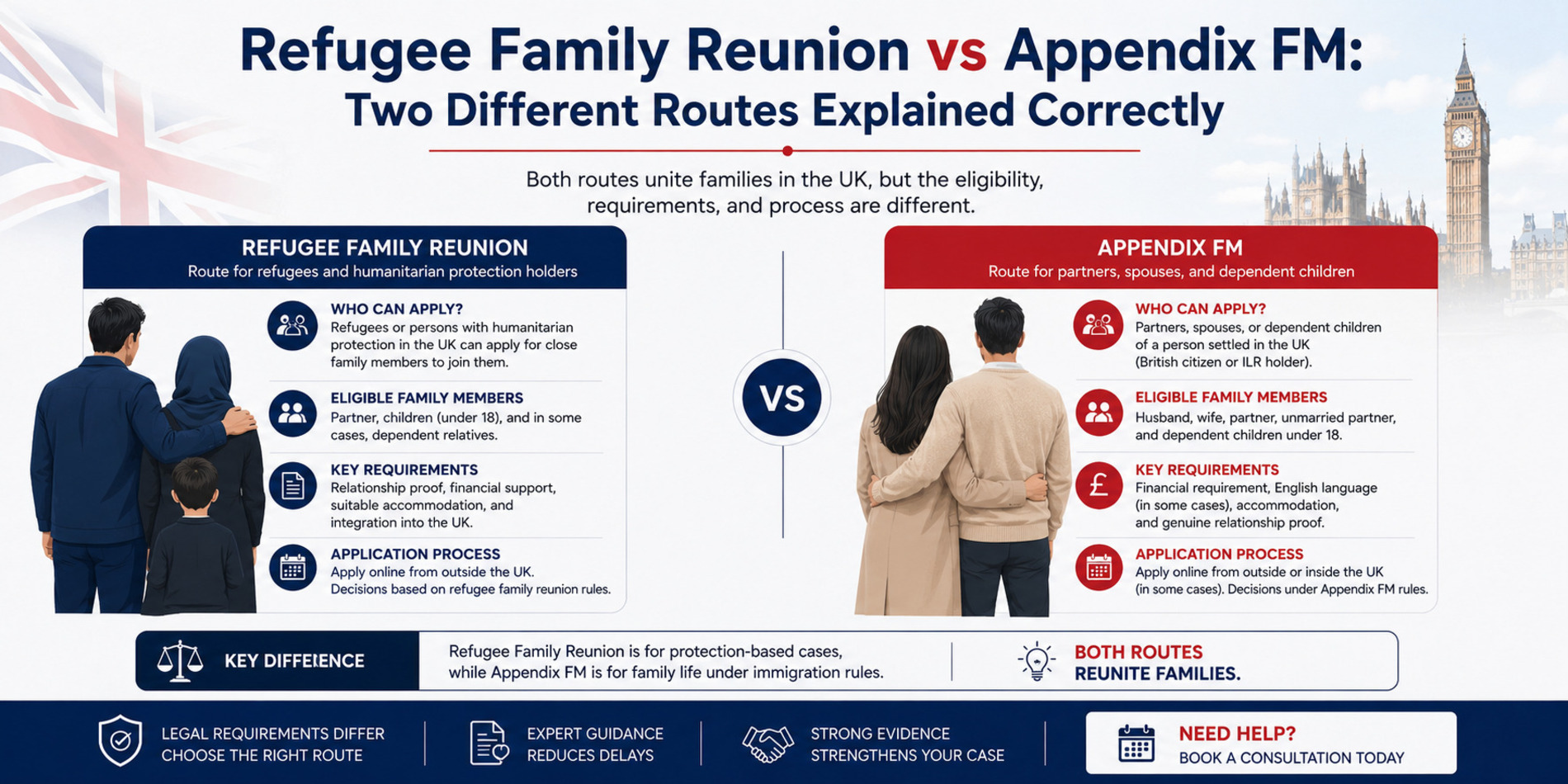
Confused about refugee family reunion UK and Appendix FM? Learn the key differences, eligibility rules, and the right route for your family. Explore now.

The UK High Potential Individual (HPI) visa lets graduates of the world’s top-ranked universities work, look for work, or run a business in the United Kingdom for two years (three years for PhD holders) without needing a job offer or a sponsor.

A UK Dependent Visa allows the spouse, civil partner, unmarried partner, or child under 18 of a main visa holder to live in the United Kingdom for as long as the main visa is valid.

Indefinite Leave to Remain (ILR) is the UK immigration status that lets you live, work and study in the United Kingdom without any time limit. Once granted, you can stay forever, switch jobs freely, claim public funds, and after 12 months you become eligible to apply for British citizenship.

Understand UK Student Visa Requirement, updates, eligibility, costs, and application steps for 2026. Explore your UK student visa application process.

UK Family Reunion Visa explained clearly—documents, process, and approval tips. Avoid common delays and apply with confidence. Learn more.

Apply for a Sponsor Licence UK with a clear step-by-step process. Avoid delays and errors. Learn what documents and checks matter most.

Explore the types of UK work visas in 2026 and find out which option best suits your skills, job role, and career goals.

Learn about the UK eVisa 2026, including ETA, application steps, requirements, and the latest updates to help you travel to the UK smoothly.

Check UK tourist visa requirements for 2026. Learn documents, eligibility, and steps to apply. Start your UK visit visa application with expert help.

GMS Immigration is a trusted UK-based visa consultancy offering expert guidance for visitor, work, family, and settlement visas.With over 10 years of experience and a high success rate, they provide personalised, transparent support to help clients achieve their UK immigration goals.