

Why did the UK government raise over £3,000 million in immigration fees in 2024, alongside an additional £2,600 million in health surcharges? For temporary visa holders, these rising costs make permanent residency a vital financial goal. Securing settled status ends the cycle of costly extensions, NHS surcharges, and employer sponsorship requirements.
However, keeping your stay lawful means navigating the strict ILR pathway timelines UK before your current visa expires. By exploring the different indefinite leave to remain routes to audit your travel and financial records early, you can avoid costly errors and prepare a secure submission.
Choosing the right track requires looking closely at your residency history and the active immigration rules. The Home Office provides several distinct pathways to settled status, but they operate under very different conditions. Making a mistake here can mean starting your residency clock from scratch.
Applying for settlement currently costs £3,226 per applicant under the updated April 2026 Home Office fee structure. Given this massive cost, analyzing the standard ILR pathway timelines UK is crucial before you submit.
To understand your position, you should check ILR options UK.
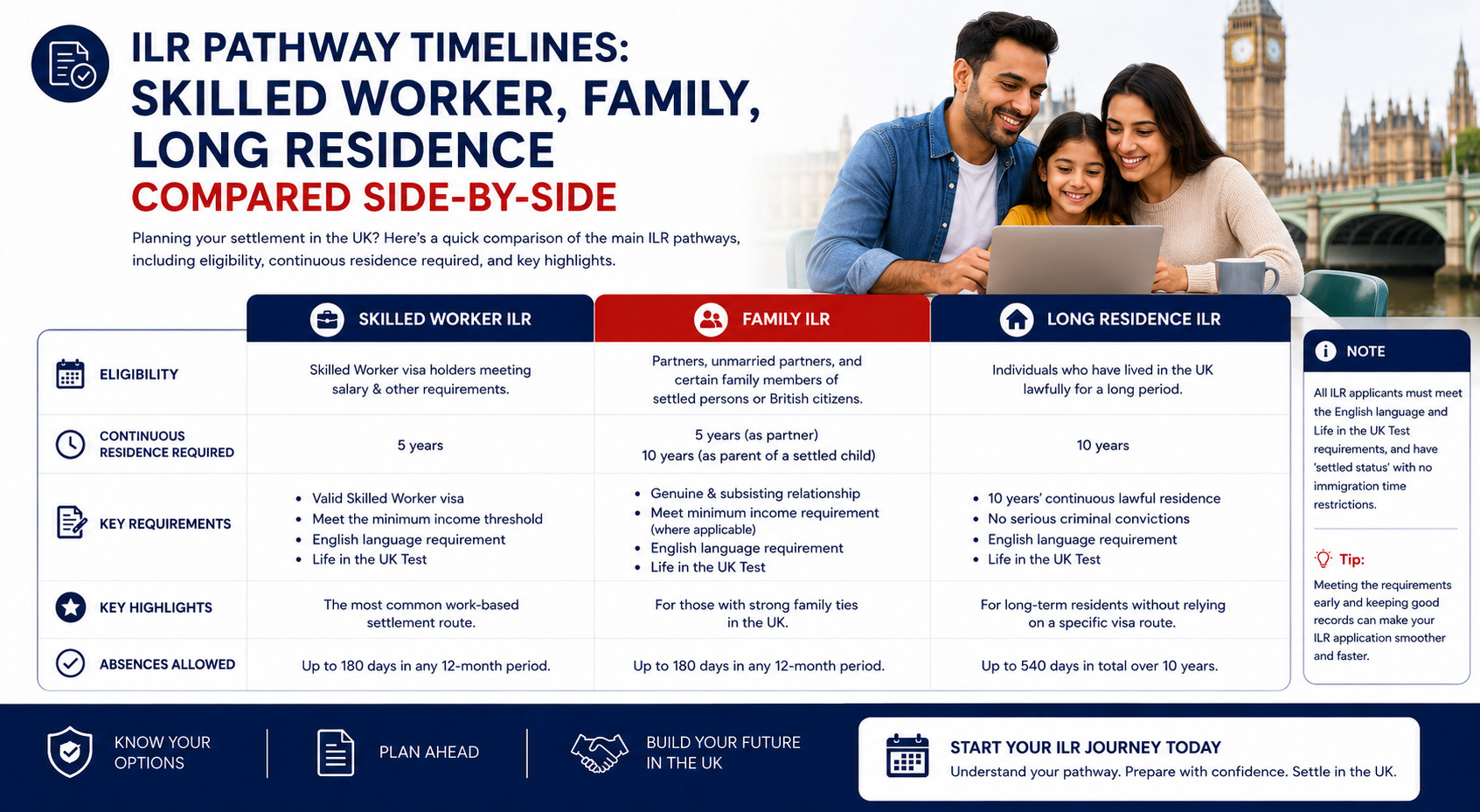
Under Appendix Skilled Worker, you typically qualify for permanent residency after completing five continuous years. During this period, you must not exceed 180 days of absence in any rolling 12-month window. This continuous residency test is calculated strictly on a rolling basis, meaning a single heavy travel block can break your qualifying time. Sponsoring employers must also verify that your role is still required and meets the relevant salary thresholds. Both routes demand meticulous planning to ensure you align with the correct ILR pathway timelines UK.
For those holding partner visas under Appendix FM, the five-year path is also available but excludes the strict rolling 180-day travel limit. However, you must still prove that the UK remains your primary home and that you intend to live with your partner permanently.
If you have a mixed visa history, the ten-year Long Residence route allows you to aggregate time spent across different visas. This option is highly popular for those transitioning from student visas to work-based visas. It counts your total time in the UK rather than requiring you to stay on a single visa type.
But switching categories often triggers a clock reset. For example, years spent under the Appendix Student do not contribute towards the five-year work path. Your five-year countdown to settlement starts completely fresh from the date your Skilled Worker permission is granted, forcing many to rely on the ten-year-long residence pathway instead.
Which Route Should You Choose?
Choose the 5-Year Route if you are currently on a Skilled Worker visa with ongoing qualifying residence, comfortably meet the salary threshold, and want to settle as quickly as possible.
Choose the 10-Year Route if you have a mixed visa history, student years, or category switches that prevent a clean 5-year count.
The landscape of British immigration undergoes continuous revision, meaning that settlement strategies must adapt alongside changing Home Office policies. The proposed transition towards an "Earned Settlement" model has introduced significant changes to standard residency clocks.
These upcoming frameworks aim to link permanent residency eligibility directly to salary levels and economic contribution. Consequently, anyone planning their long-term stay must monitor these policy shifts to protect their status and plan their applications effectively. This directly changes how the ILR pathway timelines UK apply to your specific situation.
The Earned Settlement Model and Salary Tiers
Under the proposed earned settlement model, the automatic five-year route to permanent residency is set to be replaced by a tiered system. For many sponsored employees, the baseline timeline to qualify for settlement could double from five years to ten years. These shifts alter the standard ILR pathway timelines UK dramatically.
However, the Home Office intends to preserve faster timelines for those who meet specific high-salary thresholds. The current consultation frameworks outline three distinct salary-linked tiers that determine residency requirements:
For those employed in roles below RQF Level 6, the qualifying wait for settlement could extend up to 15 years.
The transition to the earned settlement framework also introduces the "Contribution Pillar" check. Under these guidelines, fast-track applicants must prove a personal taxable income of at least £12,570 for their entire qualifying period, matching their specific tier's window.
Furthermore, language proficiency standards are being elevated. While a CEFR Level B1 in English was previously sufficient for long residence, the Home Office is transitioning to a mandatory B2 or higher requirement for work-based settlement. This change is scheduled for implementation on 26 March 2027.
Under the updated guidelines, applicants who hold a verified C1-level English qualification can reduce their qualifying period by one year. For individuals currently studying under the student visa guidelines, transitioning early to a qualifying work route is essential to avoid being caught by these extended timelines.
Regardless of the specific salary tier you fall into, the Home Office applies the 28-day submission rule with absolute precision. You are legally permitted to submit your settlement application up to 28 days before completing your qualifying residency period.
Calculating this exact date requires a careful audit of your initial visa grant date and your physical entry date into the UK. Applying even a single day prior to this 28-day window results in an automatic refusal of your application.
Crucially, because a premature application is treated as invalid, your Home Office fee of £3,226 is completely forfeited with no option to appeal. To protect your financial and legal interests, your employment letters, payslips, and P60s must be prepared well in advance. Understanding these requirements is vital to ensure your ILR pathway timelines UK remain on track.
On 2 March 2026, the Home Office introduced the "Core Protection" model, which radically transformed how the UK grants safety to those fleeing persecution. This policy dismantled the stable five-year residency grant, replacing it with a temporary leave system that heavily impacts your settlement planning. Adults and accompanied children granted asylum now receive an initial permission block lasting just 30 months. These temporary blocks directly disrupt standard ILR pathway timelines UK.
At the end of each 30 months, you must undergo a mandatory "Safe-Return Review" conducted by the Home Office. If conditions in your country of origin have improved or are deemed safe, your extension will be refused, and you may face removal. This recurring cycle of reviews significantly stretches the standard ILR pathway timelines UK for those on the protection track.
Instead of settling after five years, refugees must now complete a 20-year residency route before they can apply for permanent settlement. However, unaccompanied asylum-seeking children are excluded from this 30-month cycle and continue to receive five years of leave.
For many individuals holding temporary status, the sudden suspension of the automatic family reunion route has created severe personal challenges. To reunite with spouses or children, the Home Office actively encourages transitioning from the protection route onto standard work or study visas.
Switching to an economic visa allows you to sponsor your family, but you must then satisfy the strict financial requirements of Appendix FM. This includes proving a minimum income of £29,000 per year, which often requires securing a sponsored job that satisfies Skilled Worker criteria. Navigating these rules successfully requires a strategic understanding of your ILR pathway timelines UK.
If you are navigating these complex humanitarian and financial hurdles, preparing a compliant application under the UK family reunion visa rules is wise.
Achieving permanent residence requires early preparation and a clear understanding of your visa options. To ensure a smooth transition and meet the strict ILR pathway timelines UK, we recommend adopting the following practical timeline steps:
Establish Precise Timelines Early: Begin auditing your eligibility history and continuous residency clock at least six months before your visa expires to determine your exact 28-day submission window. This ensures you comply with the relevant ILR pathway timelines UK.
Audit Rolling Absences: Maintain a rigorous, daily travel log of all UK entry and exit dates to guarantee total absences do not exceed the strict rolling 180-day limit.
Evaluate Route Switching: Check whether switching from a ten-year private life route to the direct five-year spouse path is viable once you meet the Appendix FM £29,000 income requirement. Doing so will reduce your long-term visa fee burden. This is one of the most effective ways to accelerate your ILR pathway timelines UK.
Transition to eVisas: Ensure you link your physical BRP cards to the Home Office digital eVisa system to prevent compliance gaps during employer right-to-work checks.
Map the Path to Citizenship: Plan your post-settlement steps by consulting our expert UK settlement comparison and reviewing our Bristish nationality guidelines to secure your long-term future in the UK.
Evaluating your ILR pathway timelines UK has become a highly technical task requiring meticulous attention to dates, finances, and continuous residence. Shifting policy frameworks make proactive planning essential for anyone approaching their settlement window.
Rather than risking a £3,226 Home Office application fee on a premature or incomplete submission, you must verify every detail of your residence history. A single overlooked travel absence or minor salary discrepancy can disrupt years of careful planning. Understanding your UK ILR options is vital to ensure your ILR pathway timelines UK remain secure.
Whether you are switching visa tracks or transitioning from temporary protection routes, our advisors at GMS are here to guide your journey. Reach out to our Kent-based team to secure your permanent future in the UK.
Can I combine my student visa years with my sponsored work visa to qualify for the 5-year ILR route?
No. Time spent under the Appendix Student does not count towards the five-year Skilled Worker settlement timeline. To use your study years, you must aggregate them with your work visa time under the ten-year indefinite leave to remain routes instead.
What is the absolute earliest date I can legally submit my ILR application under the 5-year track?
You can apply up to 28 days before completing your full five-year qualifying residency period. Submitting your paperwork even one day earlier leads to an automatic refusal, meaning the Home Office will forfeit your £3,226 fee without a refund.
Does the rolling 180-day travel limit apply to partner applications under Appendix FM?
No, the five-year partner route under Appendix FM is not subject to a strict 180-day absence limit. You must simply demonstrate that you live together in the UK and intend to make the country your permanent home.
How can refugees on the new 30-month Core Protection status reunite with their families?
Because automatic family reunion is currently suspended for those on a 30-month temporary status, you must switch to standard economic or study routes. Once transitioned, you can sponsor relatives under Appendix FM by meeting the £29,000 spouse visa minimum income requirement.
Do my employer's sponsor licence duties continue after my Indefinite Leave to Remain is granted?
No. Once the Home Office grants your settlement, your employer's formal sponsorship, reporting, and tracking duties end immediately. You can work for any employer without needing a sponsor licence or visa-expiry tracking.
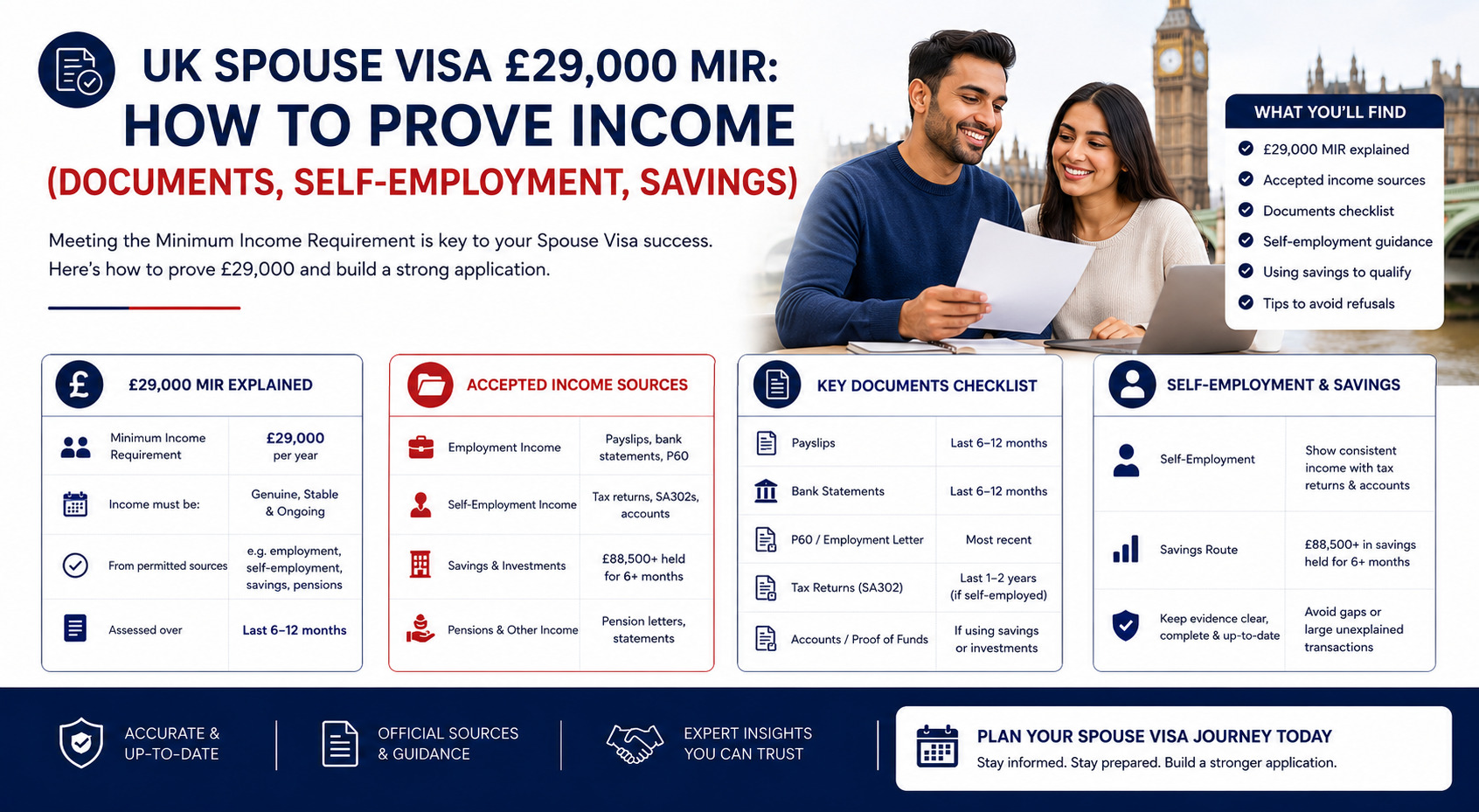
Learn which UK spouse visa £29000 MIR documents you need to prove income through employment, self-employment or savings. Explore key evidence requirements.

Discover how the Shortage Occupation List 2026 impacts reduced salary routes, sponsorship eligibility, and hiring plans for UK employers.
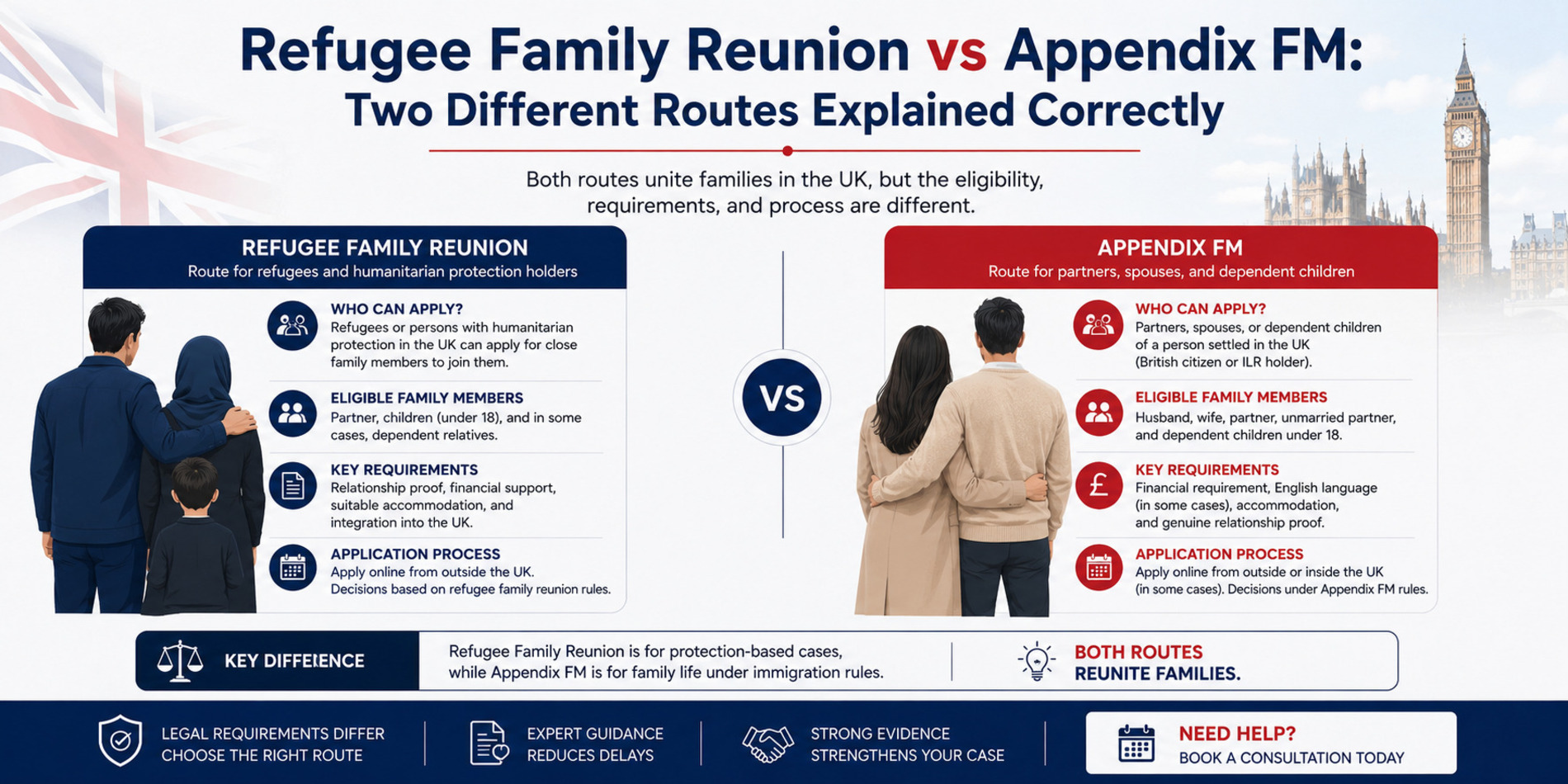
Confused about refugee family reunion UK and Appendix FM? Learn the key differences, eligibility rules, and the right route for your family. Explore now.

The UK High Potential Individual (HPI) visa lets graduates of the world’s top-ranked universities work, look for work, or run a business in the United Kingdom for two years (three years for PhD holders) without needing a job offer or a sponsor.

A UK Dependent Visa allows the spouse, civil partner, unmarried partner, or child under 18 of a main visa holder to live in the United Kingdom for as long as the main visa is valid.
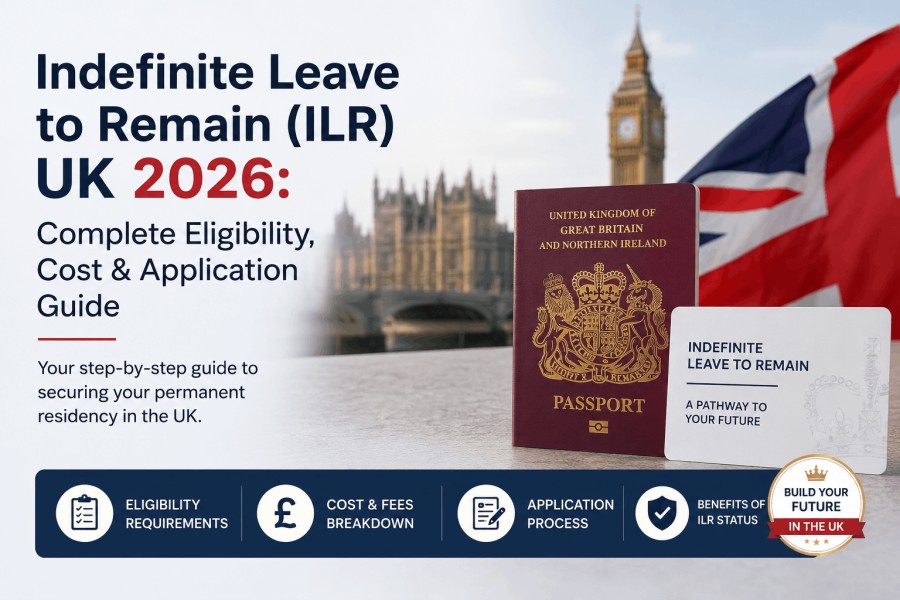
Indefinite Leave to Remain (ILR) is the UK immigration status that lets you live, work and study in the United Kingdom without any time limit. Once granted, you can stay forever, switch jobs freely, claim public funds, and after 12 months you become eligible to apply for British citizenship.

Understand UK Student Visa Requirement, updates, eligibility, costs, and application steps for 2026. Explore your UK student visa application process.

UK Family Reunion Visa explained clearly—documents, process, and approval tips. Avoid common delays and apply with confidence. Learn more.

Apply for a Sponsor Licence UK with a clear step-by-step process. Avoid delays and errors. Learn what documents and checks matter most.

Explore the types of UK work visas in 2026 and find out which option best suits your skills, job role, and career goals.

GMS Immigration is a trusted UK-based visa consultancy offering expert guidance for visitor, work, family, and settlement visas.With over 10 years of experience and a high success rate, they provide personalised, transparent support to help clients achieve their UK immigration goals.